
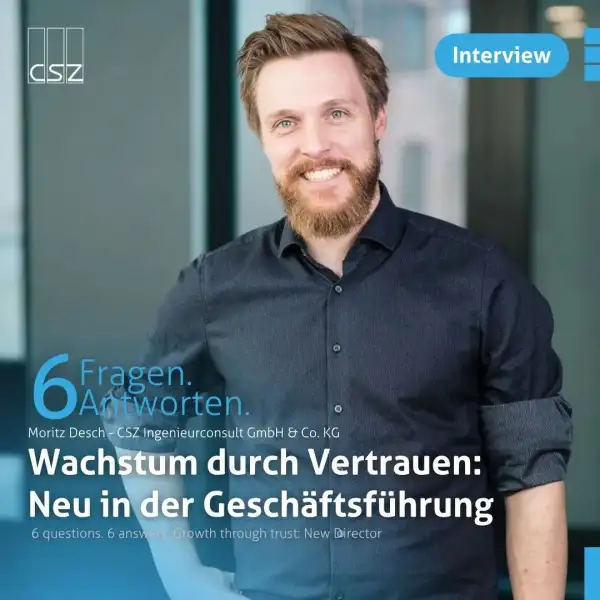
6 questions. 6 answers. An interview with Moritz Desch
9. June 2026
- How did you become the leader you are today?
I studied civil engineering at TU Darmstadt, specialising in structural design. TU Darmstadt not only provided me with a broad, high-quality technical education; my involvement in student council work and the networking opportunities there also helped me develop a keen eye for what really matters. But what perhaps shaped me more than my studies themselves was competitive sport. I competed in the decathlon at a high level for many years. The road to competing in the German Championships is a long one; it involves defeats, and it demands that you work particularly hard on the disciplines you don’t enjoy, because that is precisely where the greatest leverage for your overall performance lies. Get back up, carry on, and don’t lose sight of the long road to your goal. That remains part of my mindset to this day. At CSZ, I then saw how these values work within a company, striking a balance between support and challenge, under leadership that enables development. At some point, I realised that I was no longer just an engineer, but that I was taking on responsibility and shaping the future.
- How do you make decisions under pressure?
First, I isolate the core problem. As long as pressure and complexity are intertwined, you won’t arrive at a good solution. With a clear view of the actual issue, clearer approaches emerge, and then it’s a matter of exploring the options – as simply as possible, as solution-oriented as possible. That’s what working with existing buildings has taught me. In our projects, existing structural elements quickly reach the limit of their load-bearing capacity. Nervousness doesn’t help here; you need a level head and a focus on the facts. Letting yourself be driven by pressure is dangerous. Once you have clarity and are working within your daily routine, the approaches that really drive things forward emerge. I seek advice from people whose judgement I value. Ultimately, I make the decision myself.
- What was your biggest mistake, and what did you learn from it?
Believing for too long that technical excellence alone was enough. A project doesn’t succeed because the calculations are right, but because communication, trust and expectation management are right. I had to learn that early on, and it fundamentally changed me as a leader. Today, I place great value on an open culture of error, with the focus on the solution, not on blame. Mistakes are part and parcel of healthy employee development. Those who understand this grow both professionally and personally. And the company grows with them.
- How do you build a high-performing corporate culture at CSZ?
It starts with people. Valuing our employees is not just a cliché; it is the foundation on which everything else is built. This trust gives rise to what CSZ stands for at its core: reliability, technical precision and expertise in all aspects of engineering. Short decision-making processes, clear structures, and a team that knows its work matters. That is the culture I want to further develop at CSZ.
- What challenges lie ahead for your industry?
Our country’s economic performance has always been tied to the availability of infrastructure. Today, our structures are ageing faster than they are being replaced, and many are being operated at the end of their service life. We need to step up the pace, because without functioning infrastructure, there can be no economic growth. The policy decisions required to achieve this are not optional; there is simply no alternative.
In five years’ time, I see CSZ as a medium-sized general planner that combines all services, reduces interfaces and accelerates planning phases. And this ambition does not stop at any national border. Engineering is a universal language; quality standards, solution logic and technical thinking are the same everywhere. What drives us is the openness that has long been embedded in our team, fostered not least by our Canadian branch. Anyone who has ever worked on a project across time zones and continents changes their perspective on what is possible. And you can feel it: international projects foster a sense of identification with the collective achievement that simply does not arise in the day-to-day operations of a purely local office. For CSZ, this is not a side issue; it is part of our growth strategy.
- What drives you personally?
I want to see the structures we have planned, inspected or overseen functioning safely for decades. That is real; that is tangible. A bridge that stands and connects people is not just an abstract statistic. These are connections for people, for the next generation. This applies just as much to large, visible projects as it does to a small footpath that enables an economic contribution – one you may never see, but can certainly feel. I draw my energy from my family. They are my anchor, my support, the foundation that sustains me when my duties as managing director become particularly demanding. Ultimately, I want to be able to say: I have worked on structures that connect people, for today and for the generations to come.